What Event Occured in 1678 That O Precipitate England Into Civil War Once Again
The English Ceremonious Wars (1642-1651) witnessed a bitter conflict between Royalists ('Cavaliers') and Parliamentarians ('Roundheads'). The Royalists supported showtime King Charles I of England (r. 1625-1649) and then his son Charles II, while the Parliamentarians, the ultimate victors, wanted to diminish the constitutional powers of the monarchy and prevent what they considered a Catholic-inspired plot to reverse the English language Reformation.
Parliament, led by such figures as Oliver Cromwell (1599-1658), had superior resources and a more professional fighting force – the New Model Ground forces – which ensured the Royalists ultimately lost the iii civil wars fought in England, Ireland, and Scotland (hence the alternative name of 'Wars of the Three Kingdoms'). Tried for treason and found guilty, King Charles was executed, the monarchy was abolished, and England was proclaimed a republic with Cromwell at its head equally Lord Protector.
Causes of the Conflict
The causes of the English Civil Wars were many and varied, irresolute every bit the state of war progressed. Indeed, such was the complexity of the disharmonize, it is often divided into iii singled-out phases:
- The First English Civil State of war (1642-1646)
- The Second English Civil War (Feb-Aug 1648)
- The Third English Civil War or Anglo-Scottish State of war (1650-1651)
The state of war was only the fighting phase of a struggle that went back to the very first yr of Charles I'due south reign in 1625. King Charles' lack of compromise and unshakeable conventionalities in his divine right to rule had brought him into straight and persistent conflict with an as strong-willed Parliament that wanted a greater role in government. Parliament also wanted to forbid what it considered a steady return to Catholic practices in the Anglican Church masterminded by such Arminians as William Laud (1573-1645), the Archbishop of Canterbury. Many MPs were Puritans, and of these, the Independents or Congregationalists dominated. They wanted less power in the hands of bishops, more inclusion in the Church, and greater freedom for 'contained' congregations that assembled according to the individual believers' consciences and their own estimation of the Bible.
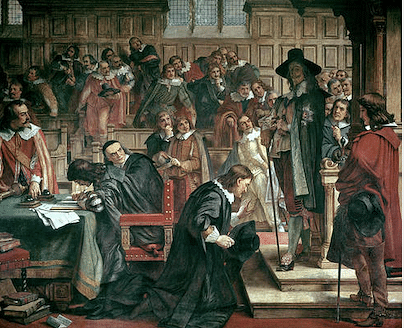
Attempted Arrest of V MPs by Charles I
The abolition of the monarchy was not the objective for the majority of MPs merely rather a removal of what were considered the king's evil counsellors and a limit on his powers, especially in terms of finance and raising taxes without Parliament's consent like the Ship Money to heighten funds for warships. These grievances and others were presented by Parliament in the Petition of Right of 1628. The king, on the other hand, saw no demand for Parliament and did not call one at all betwixt 1629 and 1640, the period now called his 'Personal Dominion', which began after his rejection of the Petition of Right.
Not all MPs were against the male monarch, & the division in Parliament encouraged Charles to search for a military solution.
Events came to a crisis point in 1639 when a Scottish army invaded northern England, the beginning of the Bishops' Wars (1639-40). These warriors were known every bit the Covenanters because they had signed a covenant swearing to defend the Scottish Presbyterian Church and its organisational head, the Kirk. Charles had fabricated several unpopular moves to change religious practices in Scotland, including imposing a new Volume of Common Prayer in 1637. In order to raise an army capable of defending his kingdom, Charles was obliged to call back Parliament. MPs seized this opportunity to forwards their case to limit the king's powers. However, Charles dismissed what has become known equally the Brusk Parliament later on 3 weeks (April to May 1640). The Scots did not go away, though, and the king yet needed coin. Consequently, another Parliament was chosen in November 1640, and this was more successful, so much then, information technology became known as the Long Parliament. Then a 2d crisis arrived: a major rebellion in Republic of ireland against English-Protestant rule, and so the king again needed funds for even so another regular army.
When MPs again presented their grievances concerning the male monarch's rule, this time in the Grand Remonstrance of November 1641, Charles again rejected them. The king, it seems, could not compromise, and he was still smarting at Parliament's trial and execution of his closest advisor Thomas Wentworth, Earl of Stafford (1593-1641) in May 1641. Stafford had been accused of preparing to bring an Irish gaelic army into England to help the male monarch, for which at that place was non much evidence, only it was a symptom of the temper of distrust betwixt the sovereign and many of his MPs. The male monarch then shredded completely any remaining fragile threads of trust between the two sides when, in January 1642, he entered the sanctity of Parliament with a grouping of armed men and attempted to abort the five MPs he considered well-nigh responsible for the Remonstrance. The five men, who included John Pym (1584-1643), a firebrand Puritan who was the rex'southward most vocal opponent in Parliament, had been warned beforehand and were not there to be arrested. Still, even at this stage, not all MPs were confronting the male monarch, and the partitioning in Parliament over how to go along with the crunch of government encouraged Charles to search for a military solution to what had hitherto been a conflict of only words. Both sides began to assemble their resources.
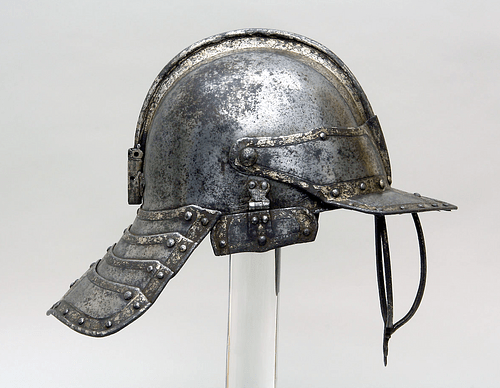
English Civil War Cavalry Helmet
Battles & Sieges
By August 1642, Charles had established himself in Nottingham where a purple army was formed. The Royalists controlled the southwest and north of England with the port of Newcastle and the valuable coal of the region. Parliament controlled London, the Royal Navy, and southeast England. The two sides became known as the 'Cavaliers' (Royalists) and 'Roundheads' (Parliamentarians). The latter name derives from some Puritans wearing their hair very brusque, but this only pertained to the early period of the state of war, in reality, many officers on both sides wore long wigs and extravagant wearable.
The English language Civil Wars involved over 600 battles and sieges, although many of these were small in scale. The kickoff major engagement was at the Boxing of Edgehill in Warwickshire in October 1642. Artillery, cavalry, pikemen, musketeers, and dragoons combined in a bloody engagement that took 1,500 lives. Prince Rupert, Count Palatine of the Rhine and Duke of Bavaria (1619-1682), the male monarch's nephew, led the Royalist cavalry with ataraxy but then wasted fourth dimension and try looting the enemy's baggage railroad train. Parliament fabricated better use of its reserve forces, and the battle ended, like and then many more battles to come up, in a draw. The king could and so accept marched on London but dithered at Banbury and Oxford, which gave Parliament fourth dimension to regroup and raise the city's militia forcefulness, the London Trained Bands. Charles then withdrew to Oxford which was made the Royalist capital letter.
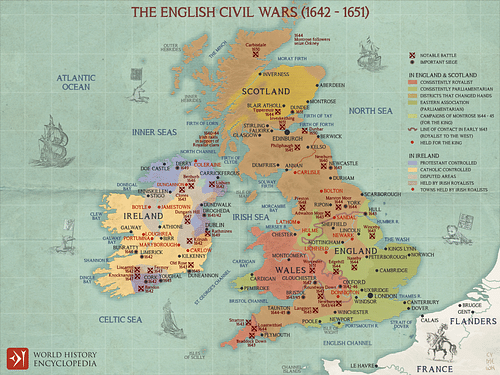
The English Civil Wars (1642 - 1651)
X more than major battles followed in the get-go one-half of 1643, and so, in July, Prince Rupert once again came to the fore in the successful Storming of Bristol, a key port and armoury. The First Boxing of Newbury in September 1643 saw fifteen,000 men fight on each side in the longest battle of the war, merely it ended in another depict. Meanwhile, there were major sieges at Gloucester (Aug-Sep 1643), Hull (Sep 1643), and and then York (Apr-Jul 1644).
The Parliamentarians had received a peachy boost in Dec 1643 when they signed an brotherhood with the Scottish Covenanters. The next significant engagement was the Battle of Marston Moor in July 1644, the largest boxing of the state of war with over 45,000 men in the field. Information technology concluded in a smashing victory for the Parliamentarian forces. Marston Moor witnessed the skills of one rising new cavalry commander: Oliver Cromwell. The victory and the fall of York just after gave Parliament control of northern England with simply a few isolated but, yet, well-garrisoned castles still loyal to the king. Charles was at least additional past the end of the rebellion in Ireland, which released some troops, merely not a dandy many, for his cause.
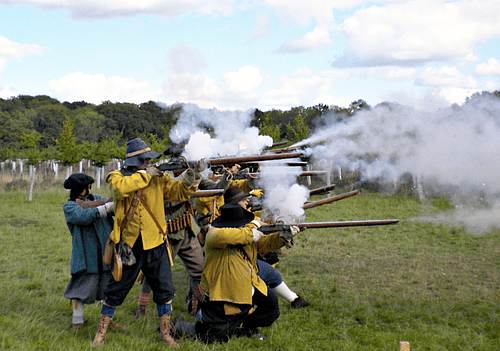
Musketeer Volley Fire
Next came the Second Battle of Newbury in October 1644. The upshot was indecisive when a superior Roundhead army should take won victory. This missed opportunity led to bitter recriminations and the determination past Parliament to reorganise its forces into a more than professionally trained and led ground forces. The outcome was the New Model Army. Meanwhile, negotiations did take identify between the ii sides at Uxbridge in early 1645, only these came to nought. Parliament'south long listing of demands, the Uxbridge Propositions, was, unsurprisingly, rejected past the male monarch. Information technology may exist that both sides were only playing for time to regroup their armies after Newbury.
The capture of Charles' personal writing cabinet revealed the monarch had no intention of ever negotiating for peace.
The Model Army's start major examination came at the Battle of Naseby in Northamptonshire in June 1645. Led by Sir Thomas Fairfax (1612-1671) and with Cromwell once over again showing his mastery of cavalry tactics, the New Model Army won a crushing victory that destroyed the king's infantry. The king fled to Wales and then to the far north of England. At the Siege of Bristol in 1645, the Royalists lost their main port. With a few more battles, culminating in victory at the Boxing of Stow-on-the-Wold in March 1646, so ended the First English language Civil War. Nevertheless, the capture of Charles' personal writing cabinet at Naseby revealed the monarch had no intention of always negotiating for peace and was even trying to engage Catholic troops from Republic of ireland to fight on for his crusade.
The 2d Ceremonious State of war
The words of Edward Montagu, Earl of Manchester (fifty. 1602-1671), now seemed to ring truer than always: "If nosotros fight a hundred times and shell him xc-nine times, he will be the King still" (Hunt, 149-150). Charles was not going to surrender and then the Second Civil War began. The summer of 1648 saw the Siege of Pembroke, the Battle of Maidstone, and the Siege of Colchester, but by August, the king's fortunes would plummet to new depths. The king had fled to the northward of England, simply he was handed over to the Parliamentarians in January 1647. He then escaped his confinement and established himself on the Isle of Wight to continue to direct the war from at that place. The Scots then became his allies as the Covenanters now considered the Puritan Parliament a greater threat to Presbyterianism than Charles. In Dec 1647, the male monarch had signed the treaty known every bit the Engagement where he promised to promote the Presbyterian Church in England. The male monarch hoped the Scots would invade the due north of England and that rebellions would arise in southeast England and Wales. This determination to continue the state of war lost him more supporters. The king was seen every bit a warmonger who would not accept defeat.
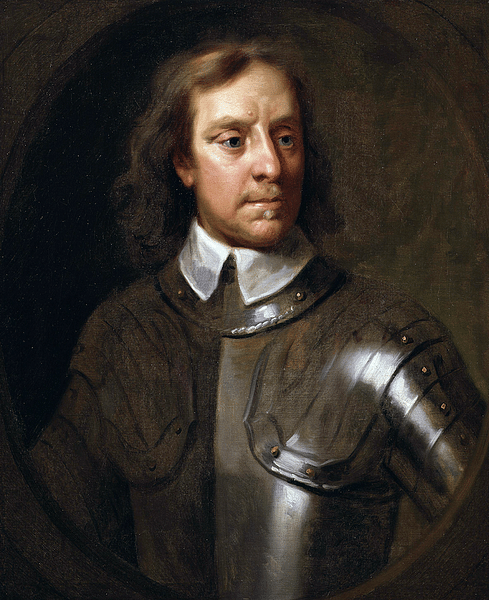
Oliver Cromwell
The planned Royalist uprisings were easily crushed or prevented altogether. At the Battle of Preston in Baronial 1648, the New Model Army, led past Oliver Cromwell, won a great victory against the Anglo-Scottish Royalists. Subsequently Preston, Cromwell recaptured Berwick and Carlisle, and he took Pontefract, bringing this brief 2nd war to a close. The male monarch was brought to London from the Island of Wight, put on trial in January 1649, and, establish guilty of treason, he was executed on 30 January. The institutions of the monarchy and the House of Lords were abolished, and England became a democracy. For these reasons, the events of 1649 are often called the 'English Revolution', although some historians disagree since the eye and lower institutions of authorities remained much the same. Crucially, though, the monarchy was not abolished in Scotland, where the late King Charles' eldest son became Charles Ii of Scotland. The ceremonious war was not quite over yet.
Third Civil War
As the third war got started, Parliament had its easily total dealing with a major rebellion by pro-Royalist forces in Republic of ireland. In the late summer of 1649, Cromwell led 12,000 men of the New Model Regular army and crushed the rebels with utter ruthlessness. The next main appointment of this third phase of the civil war was the Battle of Dunbar in September 1650.
Later on Ireland, Cromwell returned to atomic number 82 the New Model Army into Scotland, where Dunbar, just across the border, became his supply base. Cromwell tried several times to assault Edinburgh but was not successful, and then, while retreating to Dunbar, the Scottish pursued the invaders. Cromwell could very easily accept been trapped, and his army faced disaster, but the poor positioning of Scottish troops meant he could, over again, use his superior heavy cavalry to winning effect. Around 3,000 Scots were killed and perhaps 6,000 taken prisoner after the battle. Edinburgh was then captured on Christmas Eve of 1650. The remaining Scottish ground forces was defeated at the Boxing of Worcester in September 1651. So ended the English language Civil Wars. Charles II fled to French republic. In England, Oliver Cromwell eventually became Lord Protector, caput of the military machine land known equally the 'Commonwealth' Republic that lasted until 1660 and the Restoration of the Monarchy that saw Charles finally crowned Rex of England.
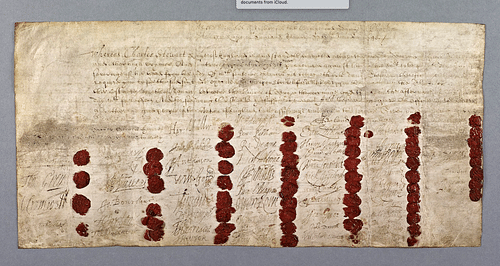
Warrant for the Execution of Charles I
Bear on of the Wars
The touch of the English language Civil Wars was enormous and long-lasting. Around one in four males in England and Wales were actively involved in the fighting. Not-combatants had to endure high taxes, confiscation of their country and property, destruction of their crops, forced labour to build defences, and deadly diseases brought past soldiers. One in ten people in urban areas lost their homes. Around 100,000 soldiers died during the conflict and some other 100,000 civilians. Taken as a proportion of the then population, these deaths were greater than those sustained in the Kickoff World State of war (1914-1918).
The political ramifications of Charles I's execution and the abolitionism of both the monarchy and the House of Lords may seem brusk-lived when considering the Restoration occurred just 9 years later on the terminal battle. However, the political landscape was changed forever since the political struggles leading up to the war had greatly increased the powers of Parliament, and these remained thereafter. Cromwell's Acts of Parliament while Lord Protector were reversed, but King Charles Two was now a monarch whose rule must exist shared with the Firm of Commons and the House of Lords.
The Civil Wars were also a religious struggle. The Anglican Church building was reformed, with bishops, clerical courts, and the Book of Common Prayer all swept abroad. The boom in printed literature provoked people'due south minds into because just what should be the obligations and responsibilities of those who governed them both in politics and in religious life. A great number of religious groups were born, some of which gave women equal rights of participation, as "the war split the country by conscience uninformed by class" (Morrill, 370). There was an temper of liberty of idea similar never before as land and Church building censorship became impossible to utilize, such was the quantity of new works being printed by men and women. The Lord Protector did steadily impose more radical Puritan practices in churches, only misguided policies like prohibiting the celebration of Christmas did nothing for Cromwell'due south popularity. Many were happy to see the monarchy return in 1660 as they hoped for a return to the old days of peace and stability earlier this terrible disharmonize had ripped the 3 kingdoms autonomously.
This article has been reviewed for accuracy, reliability and adherence to academic standards prior to publication.
carpenterloiced1971.blogspot.com
Source: https://www.worldhistory.org/English_Civil_Wars/
0 Response to "What Event Occured in 1678 That O Precipitate England Into Civil War Once Again"
Postar um comentário